AI chatbot that resolves 65% of tier-1 support tickets automatically, cutting response time from 2 hours to under 30 seconds.
- Sector
- Mobile Apps
- Stack
- Laravel · OpenAI API · WebSockets · React · MySQL
- Outcome
- 65% of tier-1 support tickets resolved without human involvement. Average first response time dropped from 2 hours to under 30 seconds. Support ticket volume handled per agent increased 3x.
01 Background
Support volume rises with customer count, but difficulty does not spread evenly across it. A large share of incoming tickets are the same small set of questions asked again and again: how to reset something, why an invoice looks the way it does, where a particular setting lives. A much smaller share are genuinely hard, specific to one account, and occasionally urgent.
The answers to the repetitive questions almost always exist already, sitting in documentation. Customers ask anyway, and it is hard to blame them. Searching documentation requires guessing the words the company chose for a thing, and asking a person does not. Given a choice between those two, most people quite sensibly ask.
The real damage is not the volume itself, it is that both kinds of ticket share one queue. A question answerable in a single line and an incident involving someone's production data arrive into the same list and get worked in roughly the order they came in. The simple ones are fast individually and relentless in aggregate, and the hard one waits behind them.
Then it compounds. The agents working through the fiftieth repeat of the same question that week are the same agents the difficult ticket needs. They are not only unavailable, they are tired in a particular way, because repetition is draining in a way that difficult problems are not. The complex ticket eventually reaches someone with less attention left than it deserved.
Seen from the outside the symptom is slow first response times. Seen from the inside the problem is that the work which genuinely needs a human is being crowded out by work that does not.
02 The Problem
A growing SaaS company was drowning in repetitive tier-1 support tickets. Agents spent most of their day answering the same questions, leaving complex issues waiting for hours.
03 What We Built
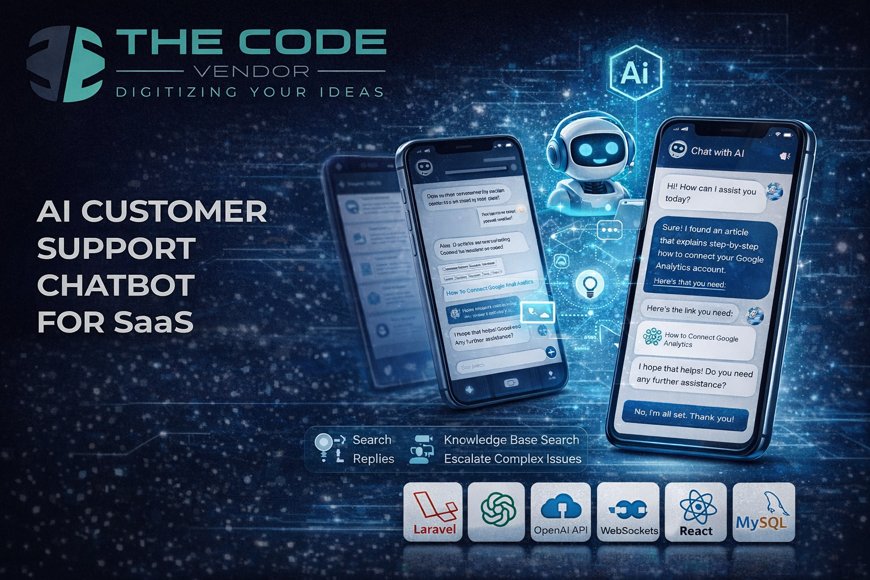
Built a custom AI chatbot integrated into the product that handles tier-1 queries, searches the knowledge base, and escalates unresolved issues to human agents with full conversation context.
04 How We Built It
The chatbot lives inside the product as a React interface over WebSockets, with Laravel and MySQL behind it and the OpenAI API doing the language work. It sits in the product rather than on the marketing site deliberately, because a user who is already signed in arrives with context that a visitor on a public page does not have.
The central decision is that answers come from retrieval rather than recall. The bot searches the knowledge base and answers from what it finds, instead of answering from whatever the model absorbed during training. This matters more than it might sound. A model asked about your product with nothing to go on will produce something plausible, and plausible is the dangerous failure mode: a confidently wrong answer about billing or data handling creates a worse ticket than the one it replaced, and costs trust that the original question never threatened. Grounding each answer in a document means there is always something a human can check it against.
The question that actually determines whether a system like this works is not whether it can answer. It is whether it knows when it cannot. A bot that resolves most things and occasionally invents an answer for the rest will be switched off within a month, because the support team cannot predict which replies they need to audit. Escalation is therefore the primary feature rather than a fallback: when the knowledge base does not support an answer, the conversation goes to a person instead of being improvised.
Escalation only helps if the handover is clean. Being asked to explain the problem a second time, to a human, immediately after explaining it to a bot, is a worse experience than never having had the bot at all - it reads as the company wasting the customer's time and then charging them for the privilege. The full conversation goes across with the escalation, so the agent opens a ticket that is already understood.
Measurement needs the same care. Resolution rate is the obvious metric and a poor target on its own, because optimising for queries closed without a human rewards exactly the behaviour you least want: a bot that avoids escalating in order to keep its number up. Escalation quality has to be watched alongside it, otherwise the system is being tuned towards confident silence.
Underneath all of it is a simple rule, which is that asking for a person always works. No confidence threshold, no routing logic and no measurement target is allowed to stand between a customer and a human being. Support tooling that traps people is the fastest way to turn a minor frustration into a cancelled subscription, and the handful of escalations it saves are never worth it.
05 Impact for the Client
Support team now focuses on high-value complex issues. Customer satisfaction improved by more than a full point on a five-point scale within 60 days of going live.
Building something similar? See how we approach AI development for SaaS and e-commerce, or hire senior engineers for your own build.