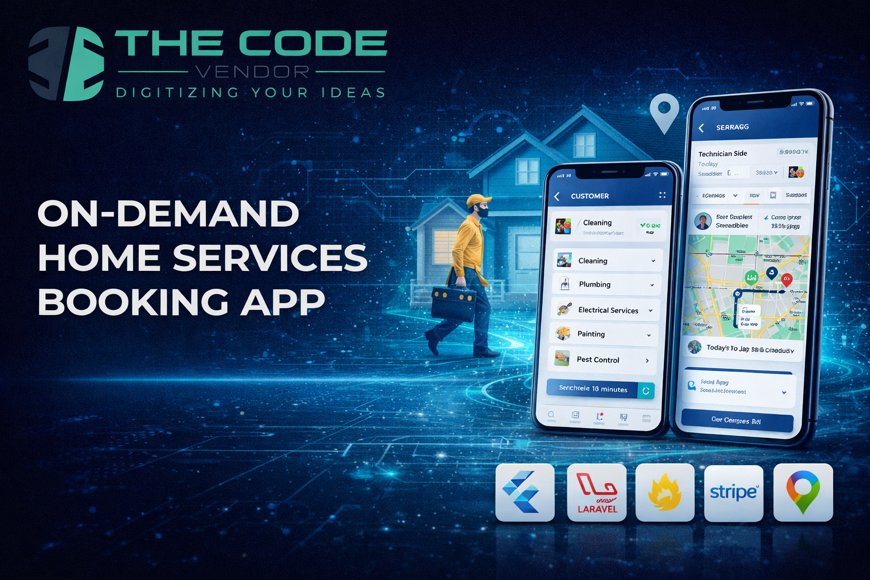
Cross-platform mobile app with real-time technician tracking and in-app payments for a home services company.
- Sector
- Mobile Apps
- Stack
- Flutter · Laravel (REST API) · Firebase · Stripe · Google Maps API
- Outcome
- Bookings increased by 120% in the first quarter after launch. Customer complaints dropped by 60%. Average booking time reduced from 8 minutes (phone) to under 2 minutes (app).
01 Background
A home services business that books by phone is running a single-threaded system. One call can be handled at a time, by one person, and everything else waits. That is invisible while the business is small and becomes the ceiling on it afterwards.
Demand does not arrive evenly either. People notice a broken appliance in the evening and on weekends, which is exactly when there is least likely to be someone answering. A call that goes unanswered at eight in the evening is not a delayed booking, it is a booking that goes to whoever picks up next. The worst part is that it leaves no trace. The business never finds out what it lost, so the problem never appears in any number anyone looks at.
The schedule has the same shape of problem. When the diary lives in one place, with one person maintaining it, two bookings can be promised into the same slot by two different routes, and nobody discovers it until a technician is standing somewhere they should not be. Rescheduling means another phone call, which means another chance for the chain to break.
For the customer, the experience after booking is the part that generates complaints. They are given a day, or at best a half-day window, and then they wait. They do not know whether anyone is coming, whether the technician is an hour away or three, or whether they have been forgotten. If they want to find out, the only option is to ring the same number and ask someone to check.
What makes this worth fixing is that very little of the dissatisfaction is about the actual work. The service gets done, usually well. The complaints are about not knowing: not knowing if the booking registered, not knowing when somebody will arrive, not knowing what to do when plans change. That is an information problem wearing the costume of a service problem.
02 The Problem
A home services company had no digital presence and relied entirely on phone calls to book, track, and manage appointments. Scheduling conflicts and missed calls caused frequent customer complaints.
03 What We Built
Developed a cross-platform mobile app with service booking, real-time technician tracking, push notifications, in-app payments, and a technician-side app for managing daily job schedules.
04 How We Built It
This is two applications sharing one Flutter codebase and one Laravel REST API, with Firebase handling push notifications, Stripe handling payment, and Google Maps providing the tracking surface. The customer app is the half that gets demonstrated. The technician app is the half that decides whether any of it works.
That is worth being blunt about. Every promise the customer app makes depends on a technician updating their status while holding tools, in someone's kitchen, often with poor signal. If that does not happen reliably, the tracking screen does not merely lose a feature, it starts lying, and a tracking screen that is confidently wrong is worse than no tracking at all. So the technician side is built to be almost not an app: a small number of large targets, one tap to change job state, nothing that requires careful reading, and no assumption of a recent flagship phone.
Live tracking carries a tension that is easy to get wrong. Accurate location means frequent updates, frequent updates drain the battery, and a technician whose battery dies at two in the afternoon will force-quit the app tomorrow. At that point tracking stops silently for every job they do. Update frequency therefore follows the state of the job rather than running flat out all day: dense while a technician is on the way to a customer, minimal when they are working or idle.
Notifications are not an add-on here, they are the product as the customer experiences it. The message confirming a booking, the message saying someone is on the way, and the message when they are close are the entire difference between waiting and knowing. Firebase delivers them, but the engineering judgement is in sending few enough that they continue to mean something.
Scheduling is the piece most likely to be modelled badly. A naive booking system treats the day as a row of empty slots and fills them, which quietly assumes technicians teleport. Jobs have locations, and the real constraint is travel time between consecutive jobs, not the slots themselves. A schedule that ignores geography produces days that look fine on screen and are impossible in a van, and the technician absorbs the difference by running late for everyone after the first overrun.
The last decision was to leave the phone line alone. It is tempting to drive adoption by making the app the only way in, and it reliably costs a business its least technical and often most loyal customers. The app had to earn its use by being faster than calling, which it is, rather than by being the only option.
05 Impact for the Client
Weekly bookings more than doubled with the same team. Customer retention improved significantly due to transparent tracking and easy rescheduling.
Building something similar? See how we approach AI development for SaaS and e-commerce, or hire senior engineers for your own build.