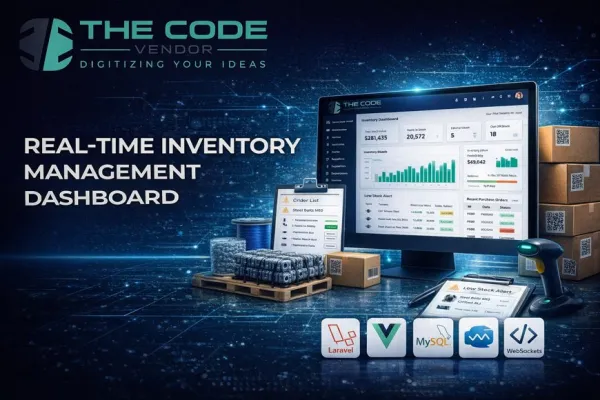
Custom B2B ordering platform that replaced WhatsApp-based order management for a wholesale distributor.
- Sector
- Web
- Stack
- Laravel · MySQL · Bootstrap · Razorpay · PDF Generation
- Outcome
- Order processing time reduced by 70%. The team now handles 3x more orders daily with the same headcount. Stockout incidents dropped significantly with real-time inventory visibility.
01 Background
Ordering over WhatsApp is not a mistake anyone makes out of ignorance. For a wholesale distributor it is genuinely the path of least resistance: every buyer already has it, there is nothing to install or learn, it works on the cheapest phone in the warehouse, and a new customer can place an order within seconds of being added to a contact list. For a business finding its feet, nothing else comes close.
It fails for a structural reason rather than a technical one. A chat thread is a log, not a record. The order exists as a sequence of messages rather than as a thing the business can query: a photograph of a handwritten list, three follow-up corrections, a voice note changing a quantity, and a line that just says "same as last month, but double the first item". Everything a system needs to know is present, and none of it is in a form anything can read but a person.
So a person reads it. Someone works through the day's threads and retypes them into a spreadsheet, and that transcription step is where the damage happens. A message read twice becomes a duplicate order. A thread that scrolls past during a busy hour becomes an order nobody fulfils. Neither failure announces itself; both surface later as an angry phone call or a delivery that never arrived.
Peak season turns a nuisance into a real cost. Volume rises sharply, the team stays the same size, and the hours that go into reconciliation are exactly the hours the business needs for selling and dispatch. The reconciliation work also gets worse precisely when accuracy matters most, because it is being done faster and under pressure.
The hard part of replacing it is not building software. It is that buyers do not have to cooperate. If the new system is slower or more awkward than sending a message, they will simply keep sending messages, and the business ends up running both systems at once.
02 The Problem
A wholesale distributor managed all orders through WhatsApp and Excel sheets, causing duplicate entries, missed orders during peak seasons, and hours of daily manual reconciliation.
03 What We Built
Built a Laravel-based B2B e-commerce platform with customer-specific pricing tiers, bulk order management, automated GST invoicing, and a salesperson dashboard for client and order tracking.
04 How We Built It
The platform is a Laravel application with MySQL behind it, a Bootstrap interface built for speed rather than polish, Razorpay for payments, and generated PDF invoices. The architecture is unremarkable on purpose. What shapes this kind of build is not the framework, it is pricing.
In B2B wholesale, price is not a property of a product. It is a property of the relationship between a product and a buyer. Two customers looking at the same item should see two different numbers, because they have different tiers, volumes and histories. That single fact rules out most of the shortcuts a consumer store relies on. The catalogue cannot be rendered once and cached for everyone, prices cannot sit in a static page, and nothing about the pricing path can be shared between sessions. Every product view resolves against the customer looking at it.
Bulk ordering shapes the interface just as firmly. A wholesale buyer is not browsing and adding one item to a cart. They are placing a forty-line order, most of which is the same as last time. An interface that is pleasant for one product and tedious for forty is an interface that loses to WhatsApp, because WhatsApp handles forty lines in a single message. Repeat ordering and fast bulk entry are not conveniences here, they are the reason the platform gets used at all.
GST invoicing is the part that is easy to underestimate. It looks like PDF templating and is not. The tax treatment of a line depends on where the supply is going, how the item is classified, and whether the transaction crosses a state boundary. The invoice is a legal document, generated automatically, at volume, with no one checking each one. It has to be right by construction rather than by review, which means the rules live in the system and not in the habits of whoever used to prepare them.
The decision that mattered most had nothing to do with code. A platform like this cannot be switched on. Buyers are habituated to a channel that works, and asking them to change on a particular Monday is asking for the thing most likely to fail. The salespeople were the ones receiving WhatsApp orders, so they were the ones who needed the tool first, with a dashboard that let them place and track orders on a customer's behalf. That made the platform the system of record immediately, even while buyers were still messaging, and it meant the business stopped depending on transcription long before every customer had moved across.
05 Impact for the Client
Eliminated 15+ hours per week of manual data entry. Monthly order volume roughly tripled without adding staff. Customers receive accurate invoices instantly on order confirmation.
Building something similar? See how we approach AI development for SaaS and e-commerce, or hire senior engineers for your own build.