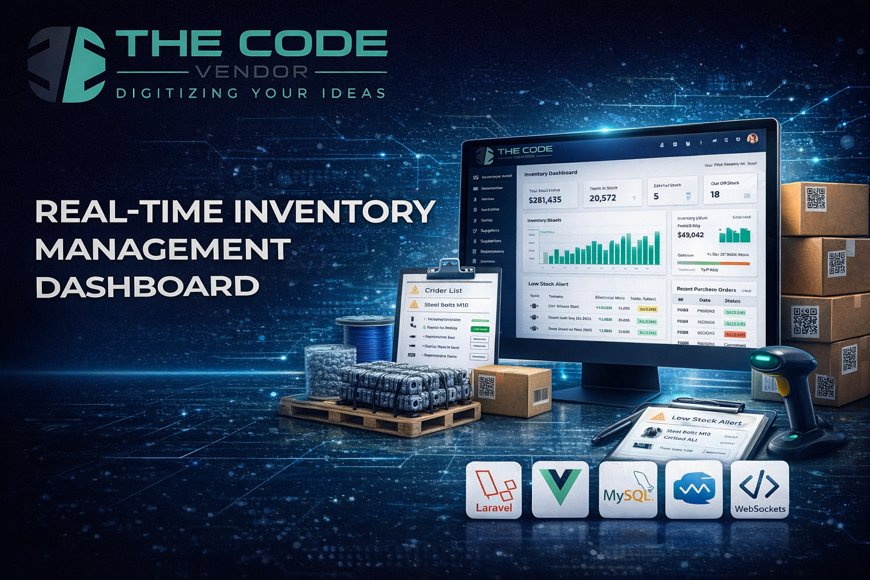
Web-based inventory system with live stock tracking, low-stock alerts, and supplier purchase order management for a manufacturer.
- Sector
- Web
- Stack
- Laravel · Vue.js · MySQL · WebSockets · REST API
- Outcome
- Stockouts reduced by 80%. Production delays caused by missing inventory dropped to near zero within two months of deployment.
01 Background
Inventory in a factory behaves differently from inventory in a shop. Stock is not sold, it is consumed into production, continuously, by people whose job is to make things rather than to record things. Every record the system holds depends on somebody on the floor noting what they took, at the moment they took it, while doing something else.
That dependency is the whole problem. When logging is awkward it gets batched to the end of a shift, and once it is batched it gets approximated. The numbers on screen slowly drift from the material actually on the shelf, and the drift is invisible until something runs out that the system believed was in stock.
Procurement is working from that same drifting picture, usually with an extra delay on top. By the time a report has been compiled, circulated and read, the situation it describes has moved on. Reordering then becomes a judgement made from a photograph of the recent past, which works until consumption rate changes.
A manufacturing stockout does not degrade gently the way a retail one does. A shop with an empty shelf loses a sale. A production line missing one component stops, and everything behind that component stops with it. The cost arrives in three parts at once: people being paid to stand still, the same material bought again in a hurry at whatever price is available today, and a delivery commitment that is now going to be late.
What the procurement team actually needed was never a stock figure. A number on its own does not tell you whether to act. The useful question is how quickly a thing is being used and how long it takes to arrive, and answering it requires consumption history that is accurate enough to trust.
02 The Problem
A manufacturing client had no real-time visibility into stock levels. Frequent stockouts caused production halts and emergency procurement at premium prices.
03 What We Built
Built a web-based inventory management system with real-time stock tracking, department-level consumption logging, automated low-stock alerts, and a supplier PO management module.
04 How We Built It
A Laravel and MySQL backend holds the record, a Vue.js front end presents it, WebSockets push changes as they happen, and a REST API connects the parts. The ordering of those responsibilities matters more than any of the technology choices.
Because the data quality problem comes first, consumption logging had to be close to frictionless and had to happen where consumption happens. Department-level logging exists for that reason: a shorter path between taking material and recording it means fewer batched entries, and fewer batched entries means the figures stay close to reality. No amount of dashboard quality compensates for inputs that are guessed at the end of a shift.
Real-time here is not a presentation feature. The reason changes are pushed rather than polled is that several people act on the same stock at the same time, and a stale screen in a factory is not a cosmetic issue - it is two departments allocating the same material, or a reorder placed against a level that was correct twenty minutes ago. The dashboard is only ever a view, though. MySQL remains the record, and a dropped WebSocket connection must never leave the system with no way back to the truth: a reload has to produce the correct number without any live connection at all.
Honesty about cost is part of doing this properly. Pushing every change to every connected client is simple to build and scales badly, because the volume of updates grows with activity while the usefulness of most of them to any given viewer stays near zero. Updates are scoped to what a client is actually looking at, which is more work up front and the difference between a system that stays responsive as the factory gets busier and one that gets slower exactly when it is needed most.
Low-stock alerting is where systems like this usually fail, and the hard part is never the alert. It is the threshold. A fixed number applied across everything is wrong in both directions at once: too high for slow-moving items, so it fires constantly for things nobody needs to think about, and too low for fast-moving ones, so it arrives after the point where reordering would have helped. A threshold worth acting on has to reflect how fast that item is actually being consumed and how long the supplier takes to deliver it.
The reason this matters so much is alert fatigue. An alert that is usually noise trains people to dismiss alerts, and after a few weeks of that the one that genuinely mattered gets dismissed along with the rest. A system that cries wolf has not just failed to help, it has removed a warning mechanism that existed before.
The supplier purchase order module closes the loop, because an alert that does not lead to an action is only a notification. The deliberate limit is that the system proposes and a person approves. Automatic purchasing against a reading that might be wrong turns a data quality problem directly into a financial one, and the saving from removing that approval step is far smaller than the cost of the first bad order it places.
05 Impact for the Client
Saved a five-figure annual sum in emergency procurement costs and lost production time. Procurement team reduced manual reorder work by 10+ hours per week.
Building something similar? See how we approach AI development for SaaS and e-commerce, or hire senior engineers for your own build.