AI pipeline that generated 5,000 SEO-optimized product descriptions in 48 hours for a large e-commerce store.
- Sector
- Web
- Stack
- Laravel · OpenAI API · MySQL · Queue System · Bulk Export/Import
- Outcome
- Generated 5,000 product descriptions in 48 hours. Organic traffic to product pages increased by 45% within 3 months. Product page bounce rate dropped by 20%.
01 Background
Five thousand product descriptions written by different people over several years are not five thousand versions of the same thing. They are an archaeological record. Some are detailed and genuinely useful because somebody cared about that category. Some are a single line added to get a product live. A large portion, as is almost always the case, were pasted straight from the manufacturer's own material.
That last group causes the most damage and looks the most harmless. Manufacturer copy is accurate, professional and word-for-word identical to the text on every competitor selling the same item. A search engine comparing those pages has no reason to prefer any of them, and there is nothing on the page that only this retailer could have written.
The inconsistency has a direct commercial cost too. A shopper comparing two items in the same category finds a thorough description next to a fragment, and cannot tell whether the second product is worse or simply less documented. Uncertainty at that moment does not usually produce a question. It produces a closed tab.
Everyone involved generally knows all of this. The reason it persists is arithmetic. Rewriting five thousand descriptions properly, at even ten minutes each, is more than eight hundred hours of concentrated writing about products that are individually unremarkable. There is no week in which that work can be scheduled, no single person it can reasonably be given to, and no point at which it becomes more urgent than whatever else is happening. So it stays broken, not through neglect, but because the task has no shape that fits into a working calendar.
02 The Problem
An e-commerce store with 5,000+ products had inconsistent, low-quality product descriptions written by different people over the years, hurting both SEO rankings and on-page conversions.
03 What We Built
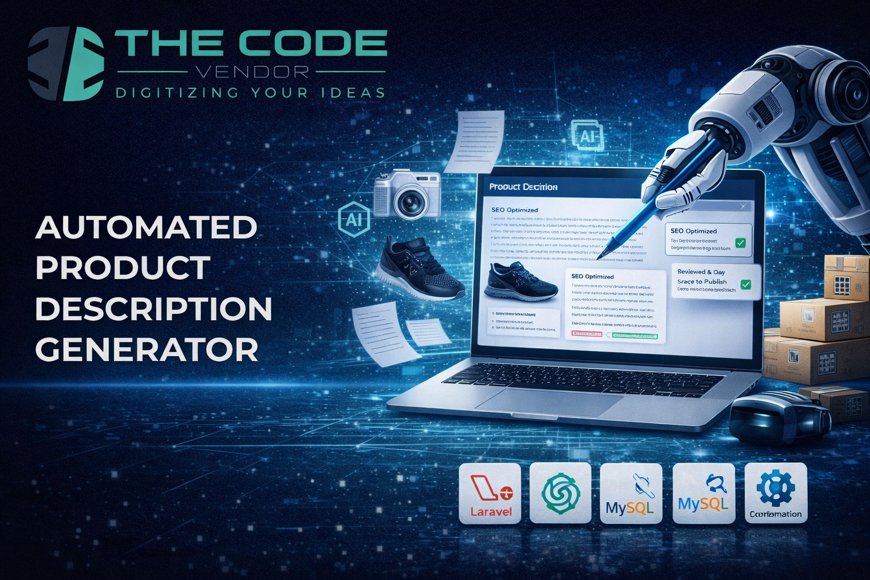
Built an AI-powered content pipeline that reads product data and category context, then generates SEO-optimized descriptions at scale using the OpenAI API, with a review and publish workflow.
04 How We Built It
A Laravel application reads product data from MySQL, a queue system drives generation through the OpenAI API, and bulk import and export move data in and out at volume. The pipeline is straightforward. The judgement is in what goes into it and what is allowed to come out.
The naive version of this project is a loop that asks a model to write a description for each product name, and it produces exactly what you would expect: five thousand pages of fluent, confident, interchangeable text. That outcome is worse than the problem it replaces. Generic copy at scale is precisely the pattern search engines have learned to discount, and a page that could describe any product in the category gives a shopper no more reason to buy than a page with no description at all.
So the input does the real work. Generation reads the actual product data and the context of the category it sits in, which means the output has specifics to anchor to: what this item is, how it differs from the one beside it, what someone comparing them would want to know. A description generated from structured attributes is describing a real thing. A description generated from a product name alone is improvising, and improvisation about products you sell eventually invents a feature that does not exist.
Queueing is not an implementation detail at this volume. Five thousand API calls cannot sit inside a request, and a bulk job of that size will encounter rate limits, timeouts and transient failures as a matter of routine rather than exception. The queue makes those survivable: individual failures retry without taking the run down, and the job resumes from where it stopped rather than starting again. Re-running has to be safe too, because a pipeline that duplicates work on a second pass costs money every time somebody is unsure whether the first pass finished.
The review and publish workflow is what makes the whole thing defensible, and it is the one part there was no case for cutting. Generated text lands in a draft state and a person decides what goes live. At five thousand items that review is quick per item, but it is the difference between a system that scales a team's output and one that publishes unvetted machine text onto a commercial storefront under the retailer's name. The pipeline removed the eight hundred hours of writing. It deliberately did not remove the judgement.
05 Impact for the Client
Saved 400+ hours of manual copywriting time. Consistent brand tone across all 5,000 products. SEO improvement led to a measurable increase in monthly revenue from organic search.
Building something similar? See how we approach AI development for SaaS and e-commerce, or hire senior engineers for your own build.